Managed Database Pricing Explained: What You Actually Pay For
A look at fixed-price managed PostgreSQL, MySQL, Redis, and InfluxDB, and why hidden line items matter more than the sticker price.
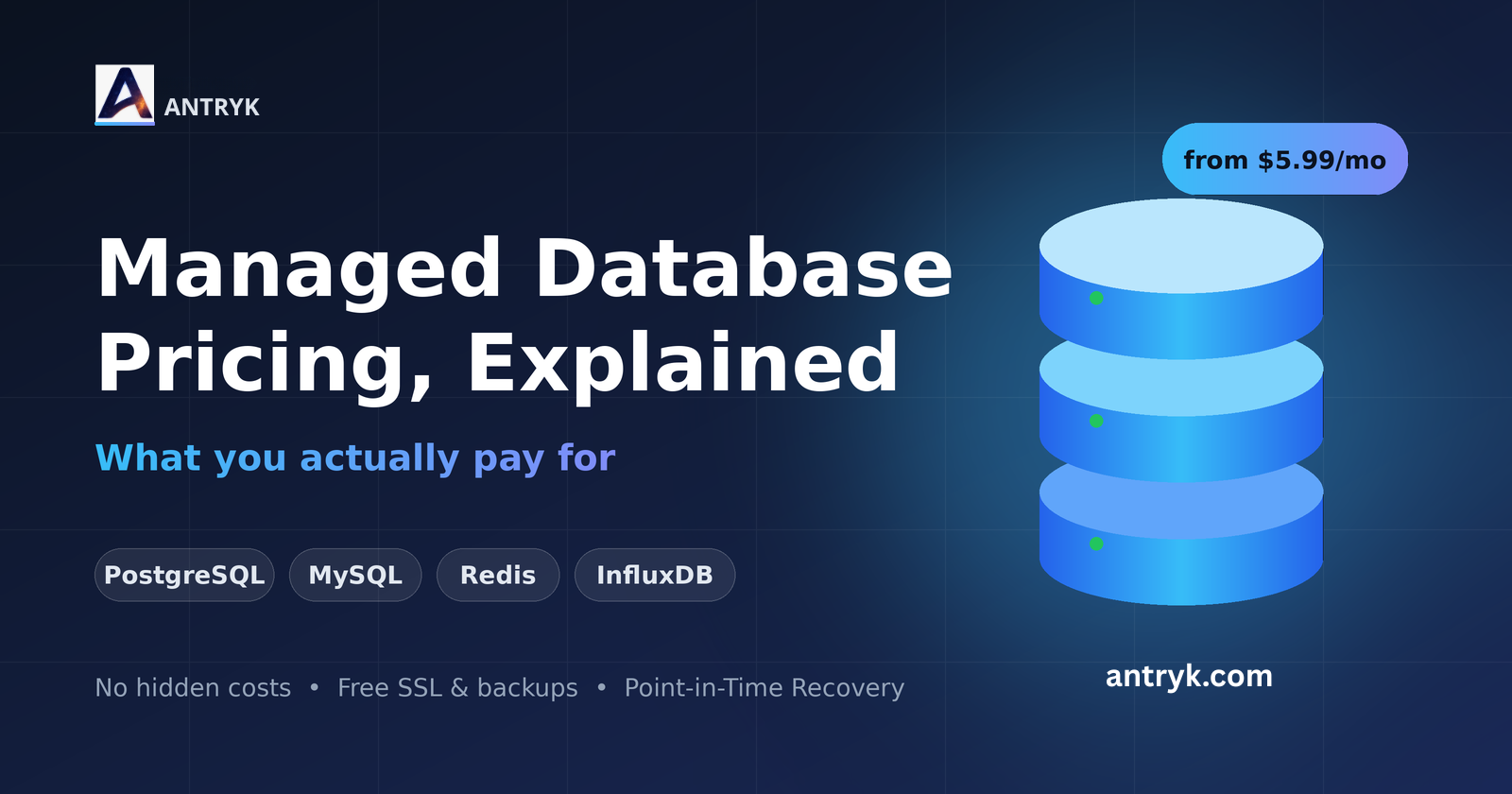
Picking a managed database usually starts with a pricing page and ends with a surprise invoice. Egress fees, backup charges, SSL add-ons, and per-query billing can turn a "$20 database" into something much bigger.
This post breaks down how fixed-price managed database pricing works, using Antryk's managed database pricing as a concrete example.
Which engines are supported?
Antryk lists four engines:
- PostgreSQL: ACID-compliant relational database with full JSON support and a large extensions ecosystem.
- MySQL: a long-established relational database with wide ORM support.
- Redis: an in-memory store for caching, sessions, pub/sub, and real-time leaderboards.
- InfluxDB: a time-series database for metrics, IoT telemetry, and monitoring data.
That covers most common workloads: relational app data, caching, and time-series metrics.
The plans at a glance
Pricing is based on compute (vCPU and RAM), and every plan includes zero downtime and storage autoscaling.
| Plan | RAM | CPU | Price |
|---|---|---|---|
| Basic-512 MB | 512 MB | 0.5 | $5.99/mo |
| Basic-1 GB | 1 GB | 1 | $11.99/mo |
| Basic-2 GB | 2 GB | 2 | $20.99/mo |
| Pro-4 GB | 4 GB | 2 | $40.99/mo |
| Enterprise-8 GB | 8 GB | 2 | $85.99/mo |
| Enterprise-16 GB | 16 GB | 4 | $171.99/mo |
Which one should you pick?
- Prototypes and low-traffic utilities: the 512 MB plan.
- Development, internal tools, and staging: the 1 GB plan.
- Small production workloads: the 2 GB plan.
- Mid-scale apps with concurrent reads and writes: the 4 GB plan.
- Data-intensive, latency-sensitive systems: 8 GB and up.
For needs beyond these, there is a custom option via the sales team.
How the pricing model works
Three things stand out compared with usage-based billing.
1. Compute tier sets the price. The monthly rate doesn't change with query volume, connection count, or data size. You can predict the bill before you deploy.
2. Storage is included. Each plan comes with a defined SSD allocation, with no per-GB overage inside it. If you need more, you move up a plan.
3. No surprise line items. According to the pricing page, there are no charges for data transfer, SSL certificates, automated backups, point-in-time recovery access, or custom domain attachment.
What's included in the price
- Free SSL: TLS encryption on every connection.
- Free custom domain: attach your own domain to the database endpoint.
- Automated backups: daily snapshots retained for 7 days.
- Dedicated SSD storage: no shared noisy-neighbour storage.
- Zero maintenance overhead: patching, upgrades, and HA failover are handled for you.
If you've paid separately for backups, replicas, or monitoring elsewhere, bundling these is where the savings tend to show up.
Point-in-Time Recovery (PITR)
A bad migration or an accidental DROP TABLE is one of the scariest moments for any team. PITR lets you restore to any exact minute within your backup retention window, and the process is designed to be non-destructive:
- Enter the recovery date and time. Pick a point within your retention window, down to the minute.
- A recovery instance is created. A new, isolated database is restored to that state while production keeps running.
- Review the data. Connect to the recovery instance, run queries, export tables, and verify before committing.
- Promote it. If it's what you need, confirm and traffic is routed to the restored database. If not, discard it and production is untouched.
Verifying before you commit is the key difference from restore flows that overwrite production immediately.
Fixed pricing vs self-hosting
Self-hosting a database on a VPS looks cheaper on paper, but you also take on:
- Patching and version upgrades
- Backup scripts and restore testing
- Failover and high availability
- SSL certificate management
- Monitoring and on-call time
A managed plan trades a predictable monthly fee for that operational work. For small teams, that is usually the better deal.
Quick checklist before choosing any managed database
- Does the price include backups, SSL, and monitoring, or are they add-ons?
- Are there egress or per-query charges?
- How long are backups retained, and is point-in-time recovery available?
- Can you scale up without migrating?
- Can you restore without overwriting production?
Frequently Asked Questions
- How much does a managed database cost on Antryk? Plans start at $5.99/month for 512 MB RAM and 0.5 CPU and go up to $171.99/month for 16 GB RAM and 4 CPU. The price is fixed per plan and is based on compute (vCPU and RAM), so it doesn’t change with query volume, connection count, or data size.
- Which database engines are supported? Antryk offers managed PostgreSQL, MySQL, Redis, and InfluxDB. That covers relational data, caching and real-time workloads, and time-series data such as metrics and IoT telemetry.
- Are there extra charges for backups, SSL, or data transfer? No. According to the pricing page, SSL, automated backups, point-in-time recovery access, custom domain attachment, and data transfer carry no separate charges. You pay the price on the plan card.
- How does Point-in-Time Recovery (PITR) work? You choose a date and time within your backup retention window, down to the minute. Antryk creates a separate recovery instance restored to that moment while production keeps running. You can inspect the data, run queries, or export tables, then promote the recovery instance to production or discard it. Your production database isn’t touched until you confirm.
- How long are backups kept, and can I use my own domain? Automated backups are daily snapshots retained for 7 days. You can also attach your own custom domain to the database endpoint at no extra cost.
Final thoughts
Predictable pricing and bundled essentials matter more than the lowest sticker price, especially for startups and small teams without a dedicated DBA. You can see the full plan details, the PITR flow, and FAQs on the Antryk managed database pricing page, or explore the documentation before you start.
Disclosure: I work with Antryk.
About the author
- Hi, I'm Muthuselvi, an SEO Executive at Antryk, a modern cloud platform for deploying and scaling apps, APIs, and databases. I write about SEO, cloud deployment, and developer tools, and I'm learning in public as I go. Find me here for practical tutorials and things I pick up along the way.
Comments
Join the discussionNo comments yet. Be the first to comment.
Cloud platform
Part of a series on choosing the right cloud platform. This post covers 5 key things to check — pricing, scalability, DX, and more — before you commit